
It’s always a gamble when you commit yourself, and your time, to an entire fantasy sports season based on a brand-new concept that is mostly untested. But when that gamble happens to pay off (the concept works brilliantly and is enjoyable for everyone), then it’s a wonderful thing.

Our newly formed Fantasy Mirror League tested out more than just one new concept, but the main pull here was my longtime passion project I call Game Peak Mode. The results exceeded my expectations. Most of the league is ready for another go at it, and we all agreed on a few tweaks that would be adjusted to make for an even better second season.
For those unfamiliar, Game Peak Mode is a scoring setup that ultimately:
- Puts more ownership into your decision making that determines your final score each week, while giving you less work to do than the typical daily lineup leagues.
- Adds a slightly different strategy with your streaming choices, while also cutting back on time spent browsing the waiver wire.
- Eliminates any imbalance of weekly player schedules.
It most closely resembles “Game Pick” on the Sleeper app, but greatly improved to allow you to get more out of your choices each week. Instead of selecting one game for each starter at the beginning of the week, Game Peak allows you to start your best players every single game UNTIL you decide to lock them in with a score. Meaning, if you own Giannis and he plays Mon-Wed-Fri this week, you can start him right away on Monday even if you think his best game might not come until Friday. If he performs well on Monday, you can lock in that score for him, which would now prevent you from starting him the rest of the week. If you would rather see if he can do better on Wednesday, you can toss out his Monday performance and continue to start him in the next game. It is all up to you as the owner to decide when and when not to lock in players throughout the week.
Here’s a breakdown of our league settings in year one:
| TEAMS | 14 |
| ROSTERS | 12 roster spots: 6 starters (2G, 2F, 1C, 1Flx), 3 IR slots |
| DRAFT | Slow, snake draft |
| ADDS PER WEEK | 3 |
| SCHEDULE | 16-week regular season, double matchups each week |
| SCORING | Game Peak Mode, Hollinger’s Game Score formula for points |
| PLAYOFFS | Top 4 from each conf. qualify, playoff rounds are two weeks long |
And here’s how it all went down:
THE DRAFT!
After getting 13 other committed owners on board, we set up the draft. The slow draft was performed like any other on Fantrax. The difference here though was figuring out the right kind of players to grab for this specific format. Ultimately, the most value came from the players who had very high ceilings. Game to game consistency wasn’t as important when you only needed to use one of their performances each week. However, those high ceiling guys still ideally needed to get you at least one great game every week, otherwise they weren’t necessarily worthy of a high draft pick.
Another small observation here was that this setup actually did a great job of eliminating the worry you might have over players who rested games in a back-to-back or sat out randomly (like Lebron). As long as they still played at least one or two games each week they still gave you enough value.
TYPICAL DAILY ACTIVITY
Once the season began, setting daily lineups was just like any other typical fantasy points league (at least at the start of the week, more on this later). After the first day of games would end, all owners who chose to lock in one or more of their Monday starters would simply send a quick message to me (the Commissioner) either privately or in the established group chat. And I do mean simple, like “Lock Luka” is all it took. We used GroupMe and Discord for the majority of our communications. Fortunately, the functionality of the Fantrax site allowed me to manually lock in the chosen players for all 14 teams throughout every week. To do this, I would go to each team page, select yesterday’s lineup date, and use the Commissioner Override to bench all starters who were not chosen to be locked in. Only locked players would stay in the starting spots. This allowed the Team Scoring page to accurately reflect the current scores each day.
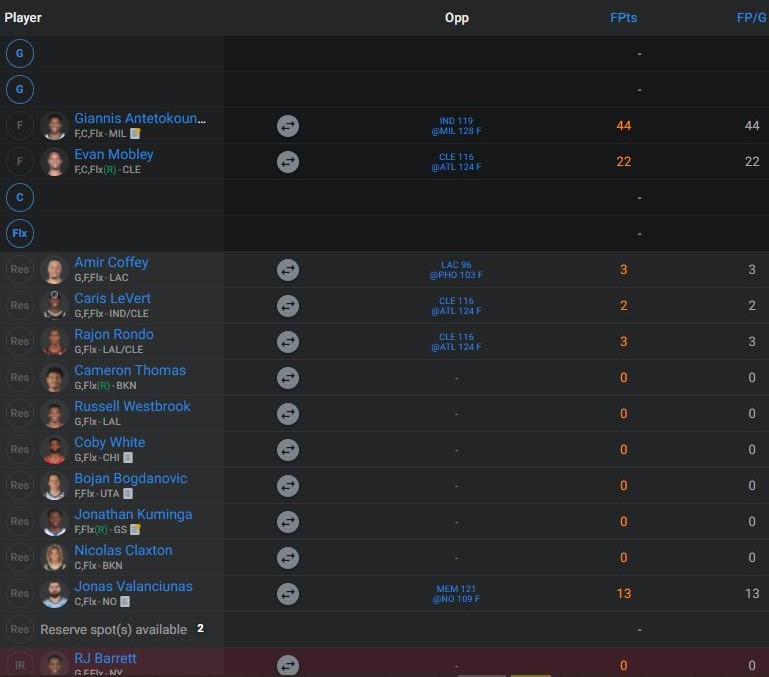
This step was really what ended up being the most work for myself as the Commish. It was imperative that I made a commitment to the entire league that I would be available around a certain time every single day of the season to make the proper adjustments before the next day’s games would begin. The other 13 owners don’t have to deal with this extra manual work at all. The further we got into the season, the less time it took to do this each day as I became more efficient with the process.
Feedback on this part of the setup was mostly positive. As great as it would be to have this part automated somehow with an app, it turned out that a simple communication from an owner for each lock choice wasn’t terribly inconvenient for anyone. And if they chose not to lock any players from a given night, they wouldn’t need to communicate anything to me. Basically, noncommunication was assumed to be “No locks for me,” and that worked out just fine for everyone.
A lock time deadline was established for some structure but was also made flexible. The only hard deadline was that all decisions had to be in at least one hour prior to the start of the next day’s first game. This ended up being mostly a nonissue as well.
As mentioned earlier, setting your lineup each day at the start of the week is just like any other. However, the interesting part is once you start locking in players for the week, you’ll see how roster management becomes important to keep an eye on. A rule was established that if you locked in Player A for the week, you were not allowed to drop that player. So once a player’s score is locked in for the week and you can no longer start him, that means less of your roster is eligible to play. So, using your limited player adds wisely becomes critical when you get to the weekend.
This is the part of the setup that we all found the most fun. Choosing your locks by looking ahead to the rest of the week became extremely important if you wanted to optimize your chances of winning. Additionally, while doing this part, you’re also constantly keeping an eye on what your opponent is deciding because that could sway you one way or the other on your own moves. Everybody’s strategy differed from week to week. It felt incredibly rewarding when you did manage to outsmart your opponent by Sunday night.
Once all spots were locked in for your team, whether it happened by Thursday or if it took until Saturday or Sunday, your work for the week was done and all you had to do was wait to see if your opponent could match you. Looking back, it seemed like most weeks would have almost half the teams fully locked in prior to Sunday, while the other half were either waiting for one more spot to fill or were going all in with a bunch of remaining spots, reliant on those players who played one last time on Sunday night.
PLAYER ADDS/DROPS/TRADES
As previously mentioned, you were not allowed to drop any players who were already locked in for the week. However, you could still trade away a locked-in player if you wanted to. Our rule we established for trades was simply that any player involved in a trade could still only be locked in for one team for that week. So, if the original owner already locks him in prior to the trade processing, the new owner can’t start him until the next week begins on Monday. If not, then the new owner can start him right away for the remainder of that week.
WEEKLY SCORES
Locking in six total spots each week would typically yield an NBA-like final score. This was intentional to add another fun visual to the league. Team scoring averages were mostly in the 100-125 range. That said, there were weeks where a team could put up over 160 points as well. Using Hollinger’s Game Score formula for our points setting turned out to be very effective in achieving the goal of NBA-like final scores, as typical locked scores would end up being over 20 for each player, while the highest player performances would be in the 40’s on occasion. This setting will continue, with the only adjustment being the addition of using decimal scoring rather than rounding to whole numbers. We had a handful of tie games that we preferred to avoid and using decimal scoring should help eliminate most of those. Whole numbers allowed us to have final scores look like a real NBA game (131-125 for example), but we decided it was more important to do more to prevent ties.
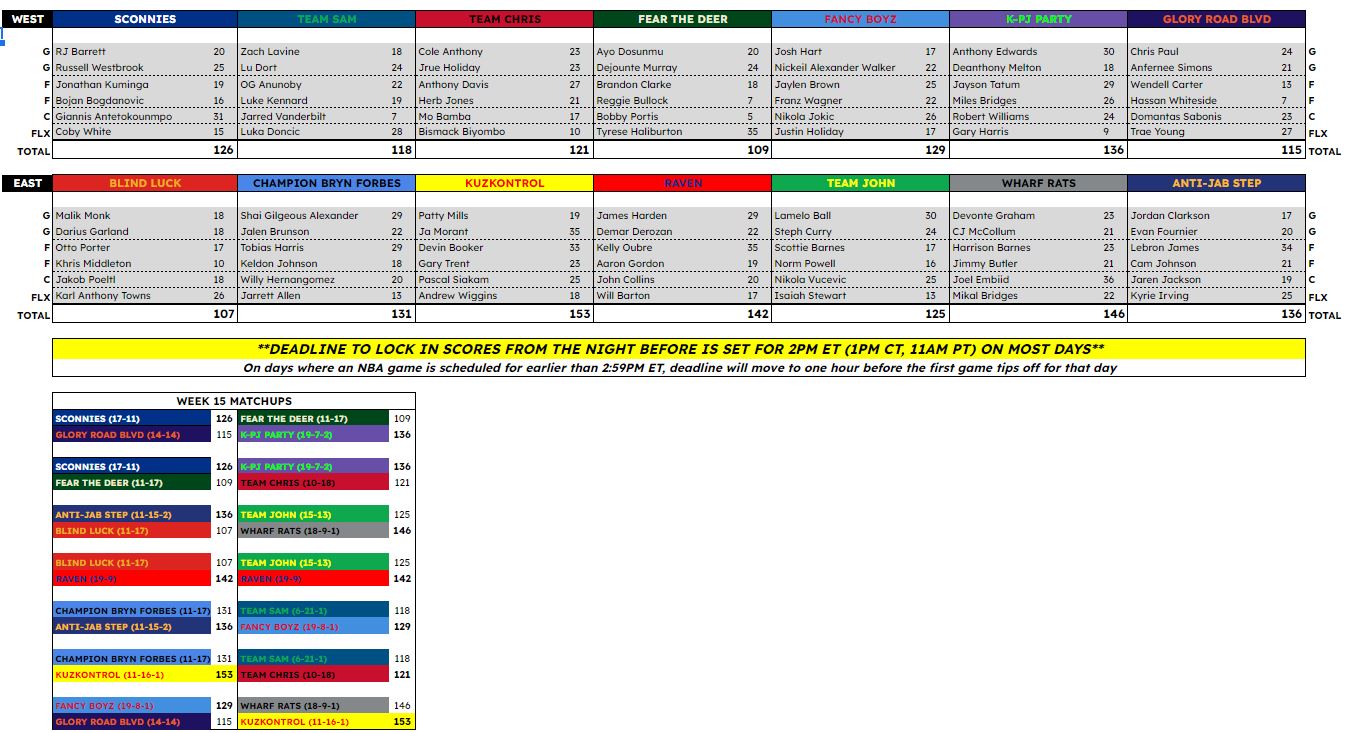
STANDINGS
Double matchups each week for 16 weeks meant that final standings reflected a 32-game regular season. Teams would play all conference opponents three times throughout the season, and all non-conference opponents twice. This specific setup also allowed us to add a newly created cosmetic feature in the form of NBA-style standings that fully resembled an 82-game slate for each team by the end of the season. It was a simple calculation where each conference game would count as three wins or three losses, while each non-conference game could count as two wins or losses. This addition had no effect on actual standings or determining playoff teams/conference winners but was mainly added as extra flair to help further replicate the look of the NBA.

As you may have already gathered, the name Fantasy Mirror League was chosen due to the many ways this new league mirrored the actual NBA from a visual perspective.
PLAYOFFS
Similarly, the playoffs took on an NBA feel in its original setup. The qualifying teams from each conference would first face off against each other, until finally we had an Eastern Conference champion and a Western Conference champion who would face off in the Finals.
The standout feature here though was using a two-legged format: each playoff round was a two-week matchup, with each week scored separately and teams assigned either the Home team or Away team. The first week of the matchup would have the higher seed team as the Home team, while the lower seed was the Away team. Then for the second week of the matchup, they would flip. The winner is determined by aggregate points scored over the two weeks. Which is simple enough, however in the event of a tie after two weeks, the winner was determined by whichever team scored more points as the Away team. If the teams were still tied at this point, the higher seed would advance.
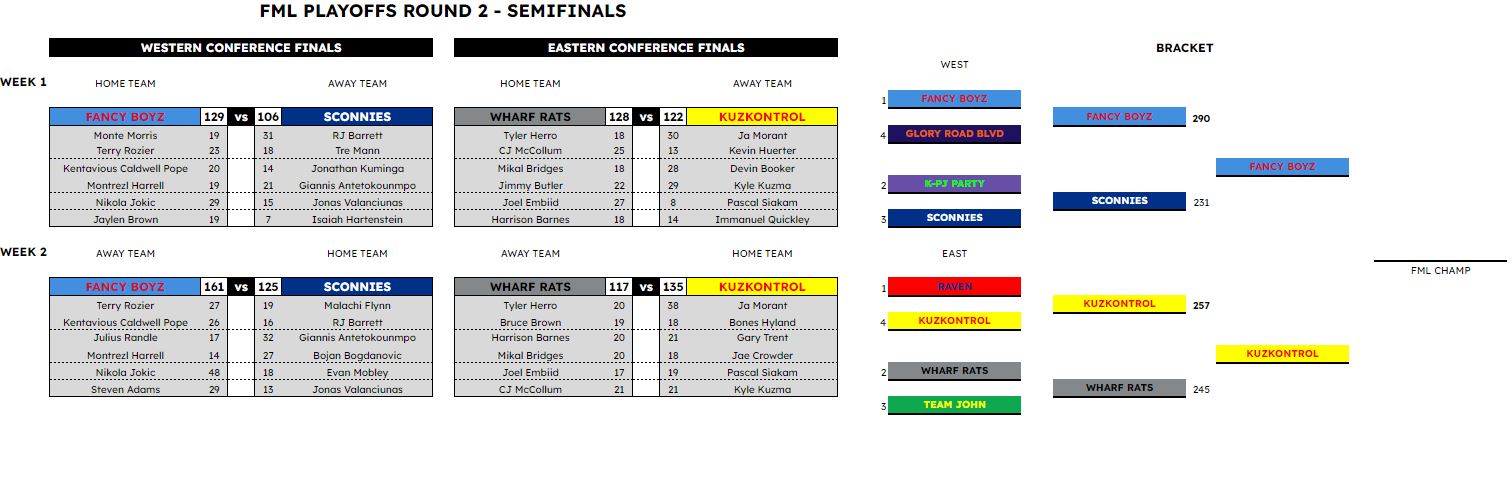
Extending the playoffs to a full six weeks was enjoyable (at least for the remaining teams), and especially worked well with the slightly shorter 16-week regular season.
CONCLUSION
The very first season incorporating Game Peak Mode into an otherwise pretty standard fantasy basketball league proved successful. Fantrax’s capabilities allowed it to be. Everyone liked the new way of thinking and strategizing day to day and supported this enjoyable alternative to the old-school way of playing fantasy hoops. It didn’t add any extra work or time spent for owners, with the exception of the Commissioner.
We are all looking forward to season two.
If Game Peak Mode is something you’d be interested in trying out for your league, and you still have questions on how any of it works, feel free to drop me a comment or message me and I’d be happy to assist.

 The Real Sim Shany
Leave a comment